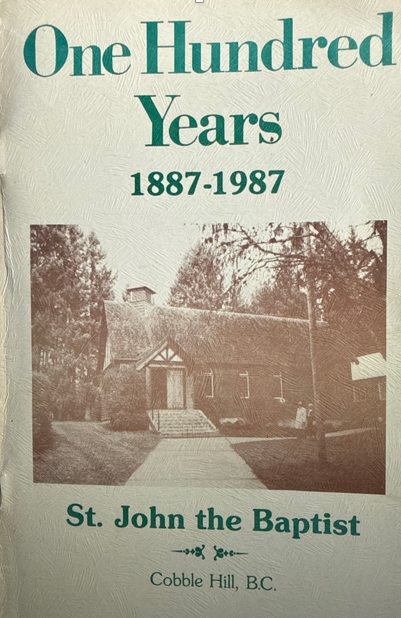
One Hundred Years
1887-1987
History of St. John the Baptist
Cobble Hill, BC
Under Construction
Click on this link or the one at the bottom of the page below to download a pdf version of this history.
Introduction
"Where is St. John the Baptist Church?" asked the middle-aged lady, who was driving along a country road in South Cowichan.
"Well," answered her companion, "according to the directions we were given, it is situated on the right hand side of this road."
"I haven't noticed a church along this road, and it looks like we are com-
ing to the end of it," said the first lady.
"We've been to each end of it," responded the second lady, "and it is surprising that we didn't see lights, and cars parked near it."
"Maybe we should turn around and travel along it once more, 1 really do want to see the show put on by the Good Companions," said the driver as she turned the car around
Two or three minutes later they saw an oncoming car turn off the road.
"Do you suppose that car is going to the performance?" said the passenger lady. "I'll take a really good look, so slow down. Slow down, there it is!" Over the century of progress, with ups and downs, St. John the Baptist Anglican Church has known similar episodes being enacted many times, and we the parishioners smile and think to ourselves - 'How could one miss it?'
The century of the existence of our Parish that we are celebrating begins before we had a church building, and is ending with three buildings: a church, a hall and a rectory; as well as a lovely country cemetery. Interspersed with all these tangible assets is the one hundred years of Christian activity that has been lived and acted upon by the many parishioners who have worked so diligently over the years.
St. John the Baptist Church
1887-1912
THE PARISH BEGINNING
During the eighteenth century, Christian missions were being established along the southwest of North America by missionaries who accompanied the Spanish explorers as they sailed along the Mexican and Californian coasts. Further exploration northwards brought missionaries to the Canadian west coast and resulted in the earliest missions amongst the Indian coastal villages.
It seems that the early nineteenth century was the beginning of the Anglican Church's history on Vancouver Island. By 1864, progress was such that the need for smaller areas became apparent and the Cowichan Missionary Society was established. It ministered to an area that began north and west of Victoria, including the east and west sides of Shawnigan Lake and the east coast of the Island as far as Chemainus.
Some of the clergy that served the area in these early years were the Reverends Mr. Garrett, Mr. Holmes and Mr. Owen; as well there was a Canon by the name of Mr. Reece. Immediately before St. John the Baptist parish was formed in 1887, the area was served by Canon Leakey. The newly-created parish of St. John the Baptist, Cobble Hill, and All Saints, Shawnigan Lake, extended from the seashore as the eastern boundary, the west being the west side of Shawnigan Lake, the south Cousins Hill and the northern extremity being bounded by Bench Road.
Mr. John Nightingale, an early pioneer in this area, was the motivating force in the efforts to have a church building in the new parish. He donated the land on which to place it and hauled the lumber from the sawmill by ox team. As he was a carpenter, he helped with the erection of the new building.
The "Quote" feature in the Daily Colonist of fifty years ago quoted the
following: -
"Fifty years ago the first Anglican Church was being constructed beside the Island Highway one mile south of Cobble Hill"
Also the same year, 1899, the eighth Synod of the Diocese of British Columbia was held with Bishop Perrin presiding. One of the motions which was made and moved by a Mr. Hayward and seconded by a Mr. W.G.H. Ellison, was that women be allowed to become members of the vestry. The motion was lost.
The Church was dedicated for worship in 1889, and Mr. John Nightingale was the lay reader. He served for twenty years in this capacity. He and some of his family, whose plaques appear in the church, were devoted to the church, and worked diligently to keep the parish active.
Some of the oldest and very fragile records that there are for St. John's Church in the archives show that individual collections at a service from the earliest times ranged from about ten cents to thirty-five cents. The total collections ranged from just over one dollar to three or four dollars. It would be interesting to compare income and expenses of today. Sometimes the services were cancelled due to bad weather and occasionally for other reasons. For twenty years, Mr. Nightingale faithfully served the parish of St. John the Baptist. After his death in 1909, his son Arthur, with the help of two other parishioners — a Mr. G. Cheeke and a Miss Davidson - carried on.
The Diocesan Synod was asked to supply clergy on a full-time basis.
The Reverend Mr. Christmas was appointed first, with whom Arthur Nightingale, Mr. Cheeke and Miss Davidson worked closely. This arrangement of clergy was not very satisfactory because the priests were not resident, or they resided temporarily and had to travel some distances in order to get to the church. Unfortunately, the early records of St. John's were lost in a fire on the Nightingale farm in 1909 or 1910.
There was a church called St. Mary's that was built beside Hutchinson Road near the corner formed by Watson Avenue. This church was built before the first World War. We heard a rumour that was related to us about the position of the two churches. "The farmers attended Saint John's Church and the others went to Saint Mary's." All Saints Church in Shawnigan Lake was serviced by the clergy that came to Saint John's.
St. John the Baptist Church
1912 - 1937
THE PARISH THROUGH WORLD WAR I AND THE DEPRESSION
The Parish experienced difficult times in the years after Mr. Nightingale's death and through the First World War. There were times when it was closed. The church in Shawnigan Lake was consecrated by Bishop Ropee on February 28, 1913
Mr. Nightingale's sons, Arthur and Clifford, along with some faithful families such as these few names - Mr. R.B. Moulton, Mr. & Mrs. G. Cheeke, Miss Davidson, Mrs. McPherson and Frank and James Porter - seem to be families that were mentioned frequently in the records dealing with vestry meetings and events that took place at this time.
After the First World War the church was eventually reopened. In 1920 a meeting was held to consider the matter of a resident priest. The arrangement that had been made before the war for the supply of clergy was now most undesirable. The parishioners present at this meeting were Mrs. Bon-ner, Mr. G.A. Cheeke, Mrs. McPherson, A. Nightingale, A. Porter and G. Wilder. By 1921 a request was made to Synod for the appointment of a resident priest. In June, 1921, the Bishop decided that this could be considered if St. Mary's would assume the responsibilities of one half of the Parish of Cobble Hill. Each would be asked to pay $240.00 per year to the stipend and fifty percent of parish apportionment.
Mr. Crewe became the first resident vicar in December, 1921, and he lived in Cobble Hill village.
However, it is to be assumed that the individual churches could not get along and matters seemed to get out of hand. The Archdeacon attended a meeting in November, 1924, to try to solve the problems. The minutes of five previous meetings were read. The Archdeacon mentioned that due to financial problems there was the threat of other parishes in the diocese being closed. He did affirm that Cobble Hill was a missionary parish. (Probably put it in a different category from the others.) One of the parishioners made the statement that the scarcity of money was due to lack of unity and class distinction. In January, 1925, at the annual meeting, at which the Bishop was in attendance, a motion was passed stating that because of existing conditions, the ministrations of the church would be discontinued after the departure of Mr. Crewe. Mr. Crewe had resigned.
The following January (1926) with the Bishop once more in attendance, a church committee was elected. Services were then arranged with the Reverend Mr. Cockshutt as the new incumbent.
The parish now seems to be off on the straight and narrow and the next big effort was the purchase of an organ. The W.A. under Mrs. Tooker was asked in 1927 to help the church committee purchase an organ from the Methodist Church in Mill Bay. The organ was subsequently purchased and installed. A pump organ, it made the floor in the church vibrate when it was being played.
From the 1933 annual minutes comes the information that a central window had been installed in the chancel; the gift of Mrs. Glossop in memory of her husband. In 1934, Mr. Parker of Mill Bay built the brick gate posts.
General maintenance and improvements were carried out, and it seemed to be that the congregation had reached a time of few worries, and that the life of the parish was peaceful.
A heavy snowfall came along in the winter of 1937. It damaged the roof of the church, which threatened the building with collapse. The following investigation revealed that the structure as a whole was most unsafe. The weight of snow on the roof had forced one wall to break away from the foundation. As well, it was found that there was severe carpenter ant damage, and that the bell tower could have collapsed in a severe wind.
The congregation realized that they were faced with erecting a new church building. However, in retrospect it seems that the snow storm was timely, as it may have saved harm coming to unsuspecting parishioners.
In the early part of this period, a church building was constructed at Shawnigan Lake under the incumbency of the Rev. G. Aitkens.
St. Mary's does not seem to be mentioned after this period. The buildings were sold and moved away, but there does not seem to be any written record of it. The Reverend Mr. Willis was the incumbent vicar at the end of this period and well into the next era.
ST. JOHN THE BAPTIST CHURCH
1938 - 1962
THE PARISH: EXPANSION OF ASSETS
How inspiring to see the progress that had been achieved in the first half century, during which the Parish of St. John the Baptist had been firmly established in Cobble Hill by the dedication and unity of its parishioners and clergy. Undaunted by the disastrous damage caused by the heavy snowfall, the parishioners addressed the first order of business for the second half-century, which was to replace the whole church building.
The parish devised a variety of money-raising events to acquire the funds needed for building a new edifice. For instance, Mrs. Fairclough, a member of the Alexander family, belonged to the Orion Club in Victoria, and was instrumental in having them hold a recital in the Cobble Hill Hall. Donations were collected from parishioners as well as numerous bake sales and bazaars.
The actual amount of the cost of the church in funds that had to be raised was three thousand five hundred and thirty-three dollars ($3,533.00). The parish had to borrow seventeen hundred dollars of this amount. The finished building, of course, was worth much more, due to so much voluntary work given by the parishioners. One prime example, mentioned by Mr. R.B. Moulton, Vicar's Warden at the time, was a gentleman by the name of Mr. Herbert Collison, of whom Mr. Moulton said,
"I do not think there was anyone who gave more free time to the work."
Mr. Donald Alexander was the contractor. When looking through the invoices, it seems that he was forever buying hardware and other supplies that were needed - and what a difference from today's prices:
1 keg 2¼" nails @ $4.60 per keg.
50 Ibs. 2" finishing nails, $6.35
Also, a Mr. A. Byrne, who transported lumber supplies from Hillcrest Lumber Company with such low costs in comparison to today. Mrs. Frances Newton relates a story about her father, Mr. Knight, who, on May 30th, 1938, took his team of heavy horses to the church to pull the foundation timbers out from under the old building at the start of the "rebuilding project," as they called it. The team was hooked on to the first timber, the horses gave a good heave, and almost fell on their knees. There was nothing but a shell left of the timber by the ants.
We thought the following report would be of interest and vividly illustrate what damage can occur in so short a time:
St. John's Church
Cobble Hill, V.I.
June 30th, 1938.
REPORT OF BUILDING COMMITTEE
The demolition of the old Church, (built in 1889 by John Nightingale) was begun on May 30th, 1938, and, being now completed, the Building Committee desires to make known the facts concerning the condition of the old building.
Sills. Of the three sills, hewn logs 12x12 inches, two were mere shells of wood full of powder, and the third broke in half when moved from its bed.
Floor and joists. The south wall was bulging eight inches out of perpendicular, dry-rot was evident everywhere, even in the lining, which it had been hoped to save and to incorporate in the new building.
Tower. This was distinctly dangerous, the top cornice
might have come down any time in a high wind.
Roof. Many of the rafters were badly cracked and there was dry-rot in them all, making the whole roof unsafe. The shingles were mere shells of wood.
Vestry. (Of more recent construction than the rest of the building.) The Committee had hoped that it might be possible to save this but, as it has been found to be seriously damaged by ants in the sills and walls, the Committee is faced with further and unexpected expense in rebuilding this also.
THE NEW BUILDING
The new building is now in process of construction, the cement foundations have been completed and the framework is now well advanced.
Financial Statement
EXPENDITURE RECEIPTS (Including loan)
To Labour $379.40 $1908.30
Material $246.86
$626.26 Balance $1282.04
The Committee wishes to express the thanks of the Pari-sioners to all who have subscribed to the Building Fund, to those who have helped by their generosity and by labour voluntarily given, and to those who have given encouragement by their sympathetic interest, and to the following: - The B.C. Cement Co., Mrs. E.M. Alexander, Mr. A. Byrne, Mr. H.T. Collisson, Mr. H. Flinn, Mr. R.J. Horton, Mr. C.
Knight, Mr. R.B. Moulton, Mr. E.C. Nightingale, Mr. W.
Parker, Mr. J.F. Reason, Capt. G.D. Sprott, Mr. H.P. Wolfe, Mr. W. Taggart, Mr. J. Briscoe, Mr. A.O. Price, and to Mrs.
Fairclough, Mrs. Maslen, and Mrs. Nightingale who have provided tea daily for the workers.
In conclusion the Committee desires to state that it would be glad to receive further donations to the Fund, and that any voluntary work would be welcome.
"C. Wace" — Chairman
"E.C. Nightingale"
"R.B. Moulton" — Wardens.
Mr. Meredith had the electrical wiring contract for the church. Mr. Alexander subsequently made and donated all the pews, the altar and the reading desk.
The new church of St. John was dedicated for services on September 11th, 1938, just about three and a half months from the beginning of the demolition of the old building. During the time that no services could be held in St. John's, the United Church in Mill Bay kindly allowed the use of its facilities to St. John's parishioners. The new church of St. John the Baptist was consecrated by Bishop Sexton on October 8th, 1944. There were 153 people who attended the first service; sixty-three of them were communicants.
1987
The Parish of St.John the Baptist, Cobble Hill, B.C.
Rector: Rev Barry Wyckham 743-3095
Rector's Warden: Peter Holmes 743-4274
People's Warden: Charles Phillips 743-9086
Treasurer” Robert Weston 748-3698